What is Laser Light and How Does It Work?
Laser Light has transformed various industries with its precision and versatility. According to Dr. Emily Chen, a renowned expert in optical physics, "Laser light is a game changer for technology and medicine alike." The ability to focus energy at incredible precision enables numerous applications, from surgical procedures to cutting-edge communication technologies.
Understanding how laser light works is essential to appreciate its impact. Unlike ordinary light, laser light is coherent and monochromatic. This means it travels in a single wavefront, allowing for high levels of focus. Industries leverage this quality to enhance productivity and accuracy. However, despite its advantages, there are challenges in utilizing laser technology effectively.
Safety is a primary concern in many applications. Misuse of laser light can lead to serious injuries. Professionals must prioritize education and careful practices. As we explore the workings of laser light, it is crucial to consider both its potential and its limitations. This knowledge can empower innovations while ensuring caution is exercised.
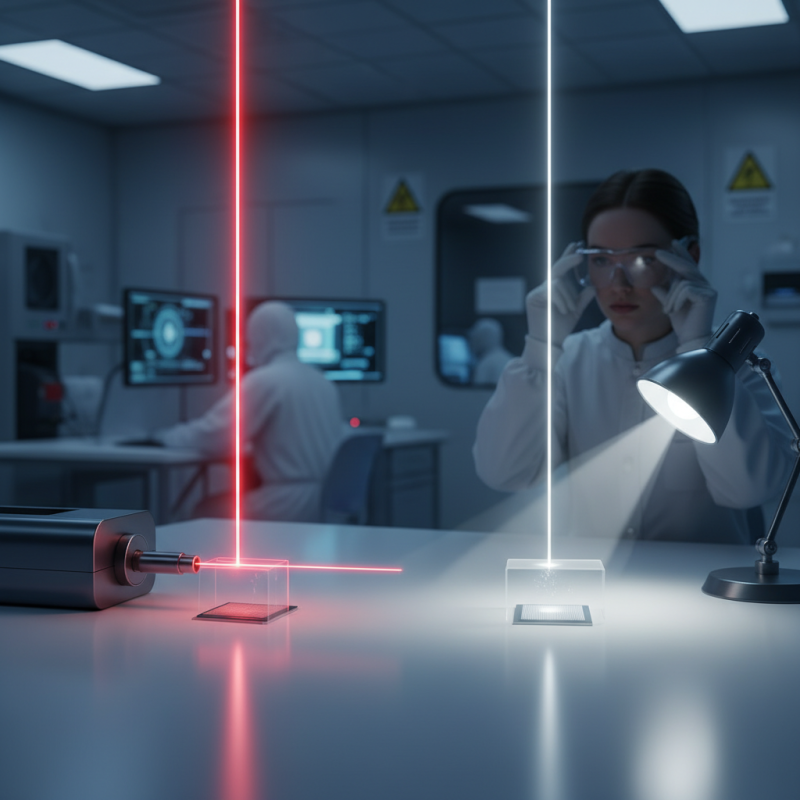
What is Laser Light?
Laser light is a highly focused and coherent form of light. Unlike ordinary light, laser light travels in a single direction. This unique property gives lasers their precision. Common examples include laser pointers and barcode scanners.
The term "laser" stands for Light Amplification by Stimulated Emission of Radiation.
Lasers work by excited atoms releasing energy in the form of photons. These photons bounce between mirrors, gaining intensity. Eventually, they emit a powerful, concentrated beam. This process is known as stimulated emission. Lasers can produce many colors, depending on the material used. For instance, a ruby laser emits red light, while a helium-neon laser gives off a bright red hue.
While lasers are valuable tools, they also have limitations. Using lasers requires caution. Improper use can cause eye damage or skin burns. Users must be aware of safety protocols and equipment. This responsibility is crucial, especially in professional settings. Understanding laser technology deepens our appreciation of its power and potential threats.
The Science Behind Laser Generation
Laser light is a fascinating phenomenon defined by its coherent and monochromatic nature. The science behind laser generation revolves around stimulated emission, a process first theorized by Einstein in 1917. In this process, an external energy source excites atoms or molecules. When these atoms return to their stable state, they release energy in the form of photons. The emitted photons can stimulate other excited atoms, leading to a chain reaction that amplifies light.
The construction of a laser involves a
gain medium, a pumping source, and an optical cavity. The gain medium can be a gas, solid, or liquid. Research by the International Society for Optical Engineering highlights that laser technologies are expanding rapidly, with a projected market growth of over
5% annually over the next decade. These lasers find applications in diverse fields such as
medicine,
telecommunications, and
manufacturing. However, challenges remain. Not all laser systems are energy efficient, and ensuring optimal performance can be complex.
Understanding the intricacies of laser light generation opens avenues for innovation. For instance, advancements in
solid-state lasers have enabled precision in applications like laser surgery. However, the balance between
power consumption and
output efficiency can be problematic. As the field evolves, continuous research is crucial for overcoming these challenges and enhancing laser technology's effectiveness.
How Lasers Work: The Principles of Light Emission
Laser light is a fascinating phenomenon rooted in the principles of light emission. At its core, a laser generates light through a process called stimulated emission. This involves exciting atoms or molecules in a medium, such as gas or crystals, causing them to emit photons. These photons stimulate more emissions, creating a cascade effect that produces a coherent beam of light. Reports from the Laser Institute of America indicate that the global laser market is projected to reach $14 billion by 2025, showcasing the expanding applications of laser technology.
When it comes to understanding how lasers operate, it is essential to grasp the role of the laser cavity. This cavity is designed to amplify light through multiple reflections. The precise alignment of mirrors within the cavity ensures that only specific wavelengths of light are reinforced, contributing to the laser's uniqueness. Some research suggests that different types of lasers, like solid-state and fiber lasers, have specific advantages in various applications, including medical treatments and industrial uses.
Tip: If you're exploring laser technology, consider focusing on the types of lasers suitable for your needs. Understanding the basics can help you select the right option. Remember, not all lasers are created equal. Each type serves a unique purpose, and mismatched applications may lead to less than ideal results.
Types of Lasers and Their Applications
Laser technology has evolved significantly, leading to various types of lasers with unique applications. The most common types include semiconductor lasers, gas lasers, and fiber lasers. Semiconductor lasers are often found in everyday gadgets like barcode scanners and laser pointers. Gas lasers, such as CO2 lasers, are widely used in cutting and engraving materials. Fiber lasers offer high precision and are commonly utilized in industrial settings and telecommunications.
In medical fields, lasers serve vital roles. They assist in surgeries and cosmetic procedures, providing minimal invasiveness and quicker recovery times. Selected types of lasers are crucial for vision correction therapies. Each type of laser has its characteristics, making it essential to understand their applications fully.
Tips: When selecting a laser for a specific purpose, consider the application and desired outcomes. Ensure you are informed about safety measures, as lasers can be harmful if misused. Always follow guidelines to prevent accidents. Not all laser types may suit your needs; take time to research and reflect on your choice.
Advantages and Limitations of Laser Technology
Laser technology has transformed multiple fields, such as healthcare, manufacturing, and research. One major advantage of lasers is their precision. Compared to traditional light sources, lasers emit light that is coherent and monochromatic. This property allows for focused beams that can target specific areas without affecting nearby tissue, making lasers ideal for surgical procedures. However, this precision can also present challenges in terms of operator skill and safety.
Another significant advantage is the versatility of laser applications. They can be used for cutting, welding, and engraving materials with great efficiency. In medical practices, lasers facilitate non-invasive procedures, reducing recovery time. Still, the limitations should not be overlooked. Lasers require careful calibration and can be expensive to maintain. In some cases, the energy created can lead to overheating, possibly causing damage if not managed correctly.
Tip: If you're considering using lasers in any application, ensure proper training for operators. Knowledgeable professionals can maximize the benefits while minimizing risks. Additionally, understanding the specific limitations of each laser type is crucial for effective use.
Despite their benefits, the reliance on lasers has raised concerns about safety. If not handled correctly, they can cause burns or damage eyesight. Practicing caution and adhering to safety guidelines are essential. This calls for thoughtful planning before utilizing laser technology in any context.
